Human connection. The most powerful tool you have.
We've spent the last 15 years leading the field of relational design. Our work and research has shown that when people come together in high connection with others they tend to:
Want to repeat the experience, whatever it is
Do the best work they're capable of
Experience better mental and physical health
Find solutions to intractable problems
Flex creatively as situations change from their expectations
Support others to develop and grow
Resolve potential conflicts effectively and creatively
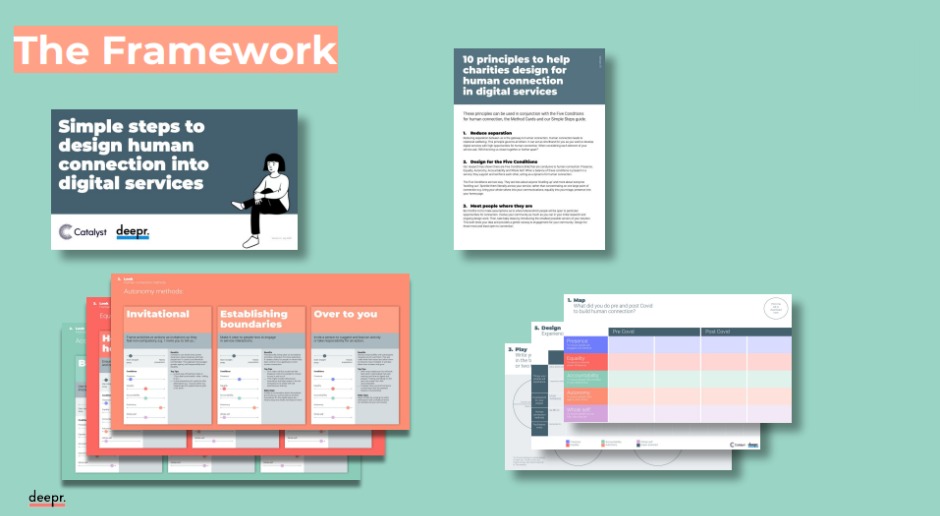
Commissioned by Catalyst and CAST, we designed a comprehensive suite of tools to design for greater human connection in all types of services, cultures and environments. We call it The Human Connection Framework.
It was awarded the Judges' Pick at the 2021 London Design Biennale and we've now delivered work based on it for clients like Google, Stanford Social Innovation Review, YMCA, Barnardo's and Grosvenor International.
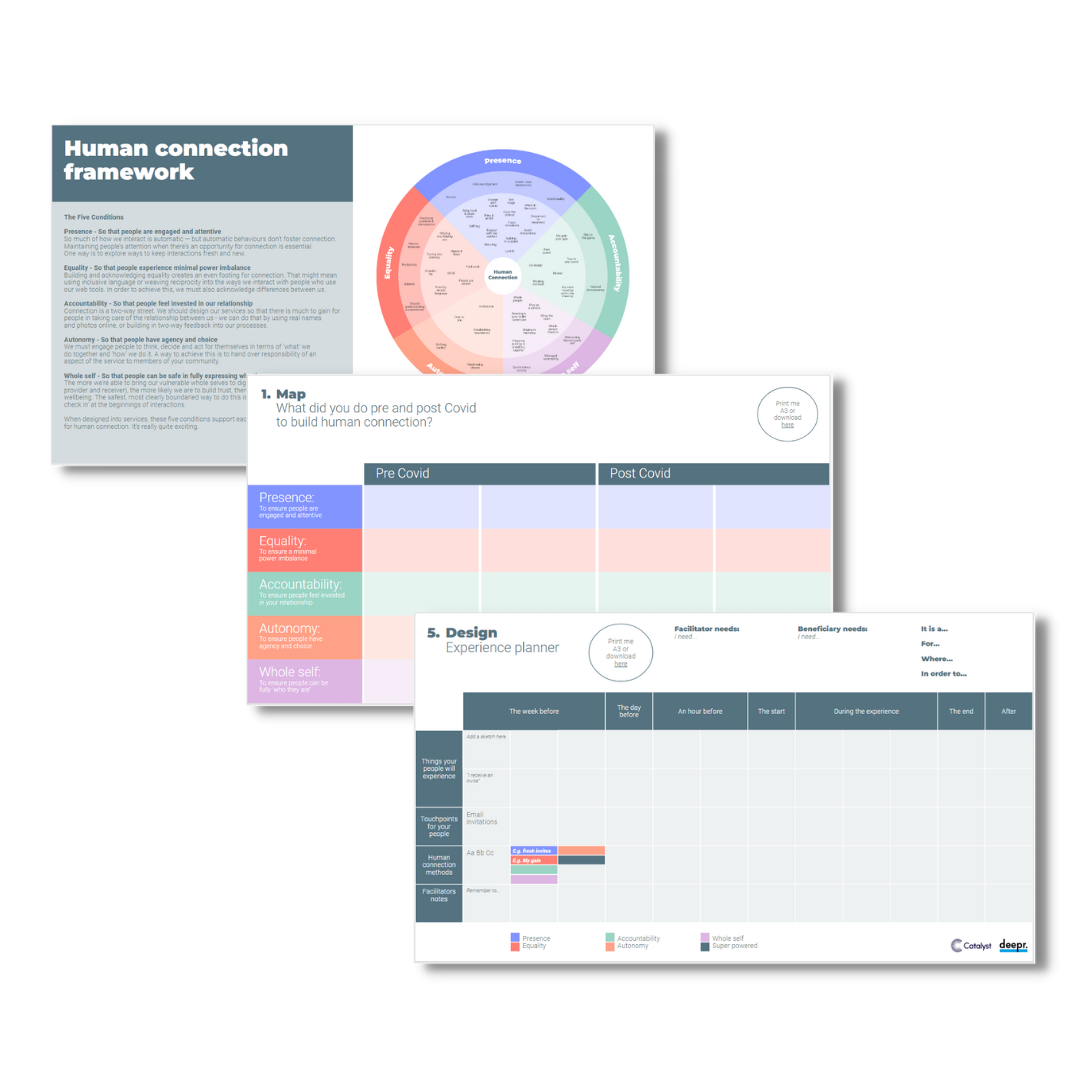
Having researched and tested with 60+ organisations, we've found the ingredients for human connection fall into these Five Conditions. When we design solutions that foster these between people, services work better, more gets done and people feel good.
01of 05
Presence
So that people are engaged and attentive
So much of how we interact is automatic — but automatic behaviours don't foster connection. Maintaining people's attention when there's an opportunity for connection is essential. One way is to explore ways to keep interactions fresh and new.
02of 05
Equality
So that people experience minimal power imbalance
Building and acknowledging equality creates an even footing for connection. That might mean using inclusive language or weaving reciprocity into the ways we interact with people who use our web tools. In order to achieve this, we must also acknowledge differences between us.
03of 05
Accountability
So that people feel invested in our relationship
Connection is a two-way street. We should design our services so that there is much to gain for people in taking care of the relationship between us. We can do that by using real names and photos online, or building two-way feedback into our processes.
04of 05
Autonomy
So that people have agency and choice
We must engage people to think, decide and act for themselves in terms of 'what' we do together and 'how' we do it. A way to achieve this is to hand over responsibility of an aspect of the service to members of your community.
05of 05
Whole self
So that people can be safe in fully expressing who they are
The more we're able to bring our vulnerable whole selves to digital interactions (as both provider and receiver), the more likely we are to build trust, then connection, then relational wellbeing. The safest, most clearly boundaried way to do this is what we call a 'whole person check in' at the beginnings of interactions.
← swipe →
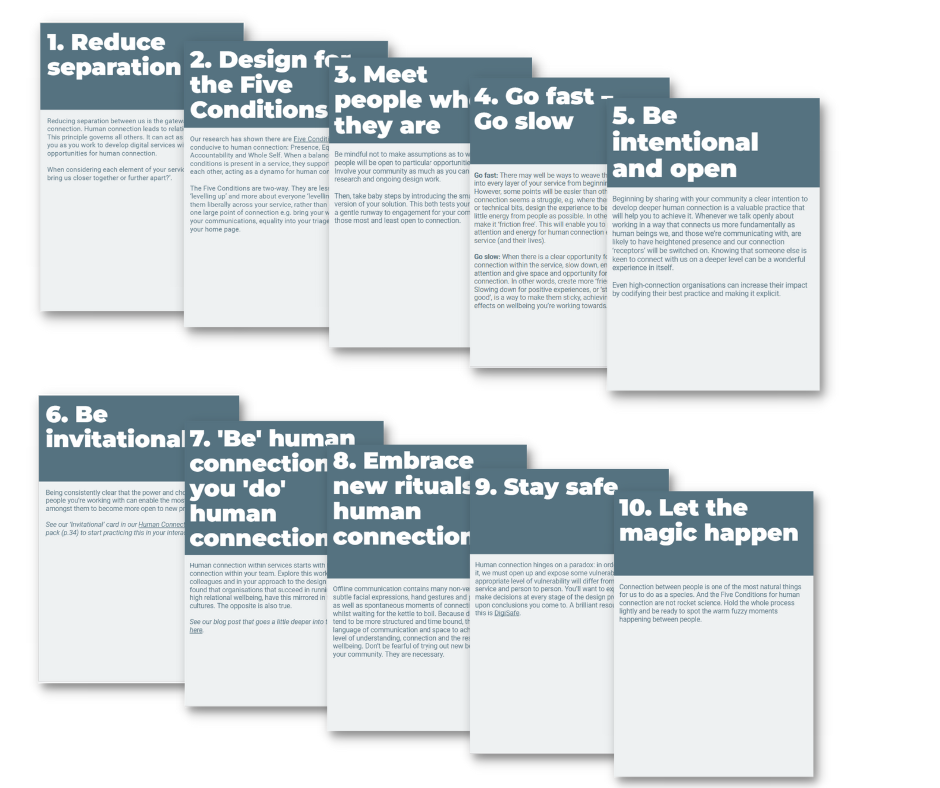
Our 10 principles
Before jumping in, take a minute to read through the principles that guide us in this work. We've developed these through research and experience. Let them guide you too.
1.
Reduce separation
Reducing separation between us is the gateway to human connection. It governs all others. When considering each element of your service ask, 'Will this bring us closer together or further apart?'.
2.
Design for the Five Conditions
Presence, Equality, Autonomy, Accountability and Whole Self. When in balance, they support and reinforce each other, acting as a dynamo for human connection.
3.
Meet people where they are
Don't assume when, where or which people will be open to particular opportunities for connection. Involve your community in research and ongoing design work.
4.
Go fast — Go slow
Where connection seems a struggle, design the experience to be fast and friction free. When there's a clear opportunity, slow down and create more 'friendly friction'.
5.
Be intentional and open
Sharing a clear intention to develop deeper human connection is a valuable practice that helps you achieve it. Codify your best practice and make it explicit.
6.
Be invitational
Being consistently clear that the power and choice lies with people you're working with can enable the most introverted to become more open to new practices.
7.
'Be' human connection as you 'do' human connection
Walk your talk. Embody the conditions you're designing for in every interaction along the way.
8.
Embrace new rituals of human connection
Digital interactions require a new language of communication and space to achieve the same level of understanding and relational wellbeing as offline ones.
9.
Stay safe
Connection hinges on a paradox: to experience it we must open up and expose some vulnerability. Make decisions about appropriate levels at every stage.
10.
Let the magic happen
Connection is one of the most natural things for our species. Hold the process lightly and be ready to spot the warm fuzzy moments happening between people.
Getting started
This short guide is a version of our own design process that will enable you to build more opportunities for human connection into digital services.
We've broken our approach down into 6 simple steps, and included some useful, practical tools, to make it really easy for you to follow.